
Contents
Overview
Middle East geopolitics refers to the intricate web of political, economic, and military relationships that shape the region, often driven by its vast energy reserves and strategic location. This dynamic arena is characterized by a complex interplay of state actors, non-state groups, and external powers, all vying for influence and control. Key drivers include the competition for oil and gas resources, historical territorial disputes, religious and sectarian divides, and the ongoing struggle for regional hegemony. The region's instability has profound global implications, influencing international energy markets, driving migration patterns, and serving as a persistent flashpoint for conflict. Understanding Middle East geopolitics requires navigating a dense history of empires, colonialism, and nation-building, alongside contemporary challenges like proxy wars, terrorism, and the rise of new regional alliances.
🎵 Origins & History
The geopolitical landscape of the Middle East is a product of millennia of shifting empires and emergent nationalisms. Ancient powers like the Assyrians, Babylonians, and Persians laid the groundwork for regional power dynamics. The rise of Islam in the 7th century CE and the subsequent Caliphates unified vast swathes of the region under a single religious and political banner, creating a distinct cultural and geopolitical identity. The Ottoman Empire was partitioned by European colonial powers, notably France and Britain. The discovery of vast oil reserves further cemented the region's global strategic importance, attracting external powers and intensifying internal rivalries.
⚙️ How It Works
Middle East geopolitics operates through a complex system of state-centric rivalries, non-state actor influence, and external power interventions. Major regional powers include Saudi-Arabia, Iran, Turkey, and Egypt. Proxy conflicts occur in countries like Syria, Yemen, and Lebanon. The OPEC (and its expanded form, OPEC+) plays a crucial role in global energy markets. Non-state actors, such as Hezbollah, Hamas, and various Kurdish groups, further complicate the geopolitical map, challenging state sovereignty and influencing regional stability. External powers, including the United States, Russia, and China, maintain significant military and economic interests, often aligning with or opposing regional players to secure energy supplies, counter rivals, or promote their own strategic objectives. The flow of arms and the management of refugee flows are critical components of this intricate geopolitical machinery.
📊 Key Facts & Numbers
Saudi Arabia and Russia often lead oil production figures. The region is home to over 400 million people, with a significant youth demographic. Military spending in the region is substantial, with Saudi Arabia and Iran consistently ranking among the top global spenders, often exceeding $70 billion and $20 billion annually, respectively. The Abraham Accords normalized relations between Israel and several Arab nations, a significant diplomatic development impacting regional alliances.
👥 Key People & Organizations
Key players in Middle East geopolitics include heads of state and influential figures who shape national and regional policies. Mohammed bin Salman, the Crown Prince of Saudi Arabia, has spearheaded significant economic and social reforms while pursuing an assertive foreign policy. Ayatollah Ali Khamenei, the Supreme Leader of Iran, guides the nation's ideological and political direction, heavily influencing its regional strategy and support for allied groups like Hezbollah. Recep Tayyip Erdoğan, the President of Turkey, has pursued a more independent foreign policy, projecting Turkish influence across the region. Benjamin Netanyahu, as the long-serving Prime Minister of Israel, has navigated complex security challenges and regional normalization efforts. Organizations like the Arab League attempt to foster cooperation among Arab states, though often hampered by internal divisions. The UN Security Council frequently grapples with regional crises, though its effectiveness is often limited by the veto power of its permanent members. The IMF and World Bank play roles in economic development and stabilization efforts across various nations.
🌍 Cultural Impact & Influence
The geopolitical dynamics of the Middle East have had a profound and often turbulent impact on global culture, politics, and economics. The region's rich history and religious significance have inspired countless works of art, literature, and film, though often filtered through Western perspectives. The "oil shocks" of the 1970s, triggered by OPEC embargoes, fundamentally altered global energy markets and consumer behavior. The rise of political Islam and movements like the Iranian Revolution have had far-reaching ideological consequences, influencing political discourse and social movements worldwide. The ongoing conflicts and humanitarian crises have fueled global debates on intervention, human rights, and refugee policies, shaping international law and humanitarian aid efforts. The region's cultural output, from ancient calligraphy to modern Arabic cinema, continues to influence global artistic trends, while its strategic importance ensures its constant presence in international news cycles and popular consciousness.
⚡ Current State & Latest Developments
As of 2024, Middle East geopolitics is marked by several critical developments. The ongoing war between Israel and Hamas has escalated regional tensions, drawing in Hezbollah and leading to increased attacks on shipping in the Red Sea by Houthi rebels in Yemen, prompting US and UK military responses. Iran continues its nuclear program, a persistent source of international concern and a key factor in its relations with Israel and Western powers. Saudi Arabia and Iran have engaged in a diplomatic thaw, mediated by China, with restored diplomatic ties in March 2023, though underlying rivalries persist. Turkey is increasingly asserting its influence in the Eastern Mediterranean and North Africa, often clashing with Greece and Egypt. The Abraham Accords continue to evolve, with potential for further normalization between Israel and other Arab states, though the Gaza conflict has strained these nascent relationships. The global energy market remains sensitive to regional stability, with fluctuations in oil prices directly linked to geopolitical events.
🤔 Controversies & Debates
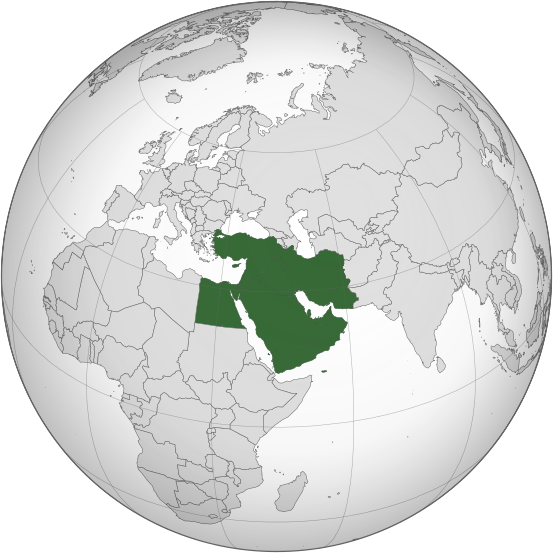
The definition of the "Middle East" itself is a subject of ongoing debate, often reflecting colonial-era perspectives and Western biases. The inclusion or exclusion of countries like Egypt, Turkey, Cyprus (geographically in Asia Minor but culturally European), and Iran (historically Persian, not Arab) highlights the fluid nature of regional identity. The role of external powers, particularly the US and Russia, in shaping regional conflicts and alliances is a constant point of contention, with accusations of neo-colonialism and interference. The sectarian divide between Sunni and Shia Islam, particularly the rivalry between Saudi Arabia and Iran, is often oversimplified in Western media, masking complex political and economic motivations behind the religious framing. The question of Palestinian statehood and the ongoing Israeli occupation of Palestinian territories remains a deeply divisive issue, impacting diplomatic relations across the region and globally. The effectiveness and leg
Key Facts
- Category
- geopolitics
- Type
- topic